
 Dr Ashu Kumar Jain
Shoulder pain at night is one of the most common reasons patients seek help. The pain may wake you when you turn in bed, stop you from lying on one side, or make simple movements feel difficult in the morning. Two common causes are frozen shoulder and rotator cuff problems. They can feel similar, but the pattern of pain and movement often gives important clues.
Why Does Shoulder Pain Feel Worse at Night?
Night pain happens because the shoulder is a sensitive joint with many tendons, ligaments, and pain-sensitive structures packed into a small space. When inflammation is present, lying still for long periods can make the joint feel stiff and painful.
Sleeping on the painful side can compress irritated tendons or joint tissues. Sleeping on the other side may also pull the painful shoulder forward, especially if the arm is unsupported.
This is why patients often say the day is manageable, but the night is difficult. Night pain does not automatically mean something dangerous, but it does mean the shoulder deserves proper evaluation if it keeps returning.
What Is Frozen Shoulder?
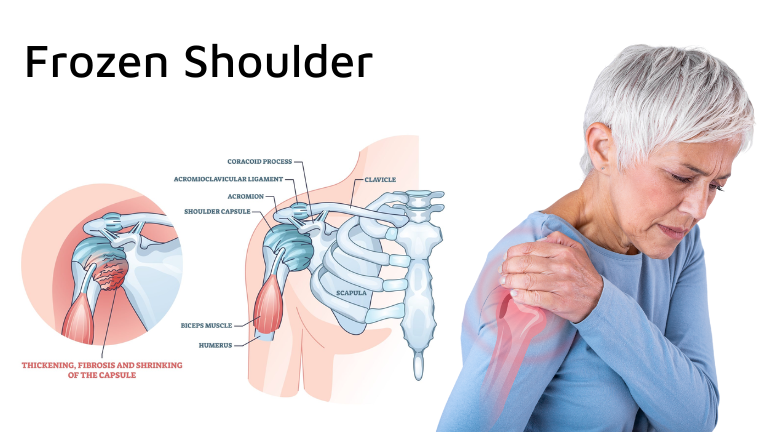
Frozen shoulder, also called adhesive capsulitis, happens when the capsule around the shoulder joint becomes inflamed, thickened, and tight. The main problem is not only pain, but loss of movement.
It usually develops gradually. At first, the shoulder may ache and hurt more at night. Over time, reaching overhead, reaching behind the back, wearing clothes, combing hair, or fastening a seat belt can become difficult.
A key feature of frozen shoulder is that movement is restricted even when someone else tries to move the arm for you. The shoulder feels blocked, not just painful.
What Is Rotator Cuff Pain?
The rotator cuff is a group of muscles and tendons that help lift and rotate the arm. These tendons can become irritated, inflamed, partially torn, or fully torn.
Rotator cuff pain is often felt on the outer side or front of the shoulder. It may worsen when lifting the arm, reaching overhead, carrying weight, or lying on the affected side.
Unlike frozen shoulder, the shoulder may still have a reasonable range of movement, but certain movements are painful or weak. In a significant tear, the patient may struggle to lift the arm even if they try hard.
The Simplest Difference Patients Can Notice
A simple way to think about the difference is this: frozen shoulder is mainly a stiffness problem, while rotator cuff pain is mainly a tendon pain or weakness problem.
In frozen shoulder, both active movement and assisted movement are limited. That means you cannot move the shoulder fully, and another person also cannot move it fully without resistance or pain.
In rotator cuff pain, the shoulder may move better when assisted, but lifting the arm yourself may hurt or feel weak.
- Frozen shoulder: pain with marked stiffness and loss of range
- Rotator cuff pain: pain with lifting, reaching, or sleeping on that side
- Frozen shoulder: difficulty reaching behind the back is common
- Rotator cuff tear: weakness while lifting the arm may be prominent
- Both conditions: night pain can occur and may disturb sleep
Can Both Problems Happen Together?
Yes. A patient can have rotator cuff irritation and later develop stiffness because they stop moving the shoulder normally. A patient with frozen shoulder may also have tendon inflammation around the joint.
This overlap is one reason self-diagnosis can be misleading. The same symptom, such as night pain, can come from different shoulder structures.
A careful examination checks shoulder movement, strength, painful arcs, joint stiffness, and neck involvement. This helps identify the main pain source instead of treating every scan finding as equally important.
"The most useful question is not only where the shoulder hurts, but how the shoulder moves."
When Is a Scan Needed?
Not every patient with shoulder pain needs an MRI immediately. Many cases can be understood through history and physical examination.
Ultrasound or MRI may be useful when there is suspected rotator cuff tear, persistent pain despite treatment, significant weakness, injury-related pain, or when the diagnosis is unclear.
In frozen shoulder, scans may look less dramatic than the symptoms feel. The restriction often comes from the capsule and joint mechanics, so examination is especially important.
What Treatments Can Help?
Treatment depends on the cause and stage of the problem. For frozen shoulder, the goal is to reduce pain and gradually restore movement. For rotator cuff pain, the goal is to reduce tendon irritation, improve strength, and prevent further overload.
Early treatment may include activity modification, short-term medicines, heat or ice, guided physiotherapy, posture correction, and sleep-position changes.
When pain is severe or movement is not improving, targeted injections can help. A shoulder joint injection may reduce inflammation in frozen shoulder. A subacromial injection may help selected rotator cuff-related pain. In some patients, nerve blocks or image-guided pain procedures may be considered as part of a broader treatment plan.
- Identify whether stiffness, tendon pain, weakness, or neck pain is the main driver
- Avoid aggressive exercises during severe pain flares
- Use guided physiotherapy matched to the diagnosis
- Consider image-guided injection when pain blocks rehabilitation
- Review progress instead of repeating the same treatment for months
When Should You See a Specialist?
You should consider a specialist evaluation if shoulder pain wakes you repeatedly at night, movement is reducing, the arm feels weak, or pain has continued despite basic treatment.
Seek timely medical attention if pain started after a fall, you cannot lift the arm, there is visible swelling or deformity, fever, numbness, or pain spreading from the neck into the arm.
At Jain Pain Clinic in Gurugram, Dr Ashu Kumar Jain evaluates shoulder pain by matching the symptom pattern, examination findings, and imaging when needed. The aim is to find the real pain source and choose the least invasive treatment that can restore sleep and function.
The Takeaway
Shoulder pain at night can come from frozen shoulder, rotator cuff problems, or a combination of both.
Frozen shoulder usually causes clear stiffness and loss of movement. Rotator cuff pain is more likely to cause pain with lifting, overhead activity, and sometimes weakness.
The right diagnosis matters because the treatment plan is different. If night shoulder pain is affecting sleep or daily movement, it is worth getting the shoulder examined properly.